- Phone: +91 9768157682 / +91 9987300609
- Email: info@tenderimpulse.com

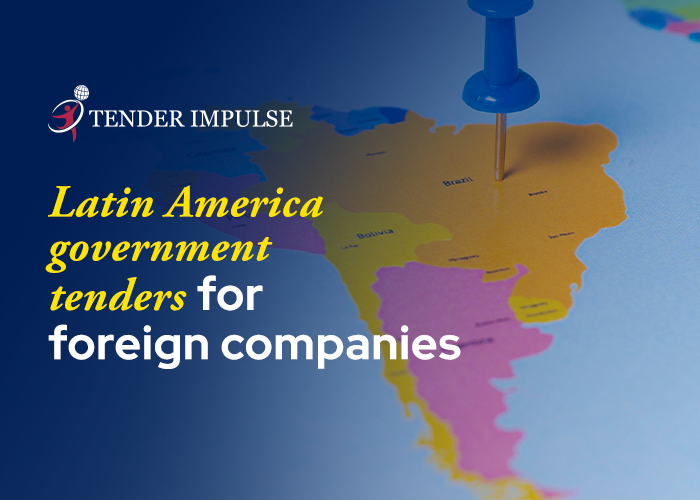
Brazil, Mexico, or Colombia First? A Foreign Bidder’s Comparative Guide to Latin America’s Government Tender Markets

Introduction: A Region Where the Paperwork Differs More Than the Opportunity
Latin America’s combined public procurement spend runs into the hundreds of billions of dollars annually, anchored by Brazil’s enormous federal and state-level systems, Mexico’s similarly large federal procurement market, and a second tier of increasingly digitized economies including Colombia, Chile, and Peru. For a foreign company evaluating where to invest its first serious effort in the region, the honest answer is that the underlying opportunity, construction, healthcare, IT, and energy infrastructure demand, looks fairly similar across the major markets. What differs sharply is the registration mechanics, the language barrier, and how seriously domestic content preference rules bite into a foreign bidder’s competitiveness. This guide compares the three markets foreign bidders ask about most, with enough procedural detail to actually act on.
Brazil: The Largest Market, the Most Codified Process
Brazil consolidated its federal procurement law in 2021 under Law 14,133, which streamlined bidding methods into five core modalities and introduced a competitive dialogue mechanism for complex procurements alongside the existing electronic reverse auction, the pregão eletrônico, that handles the bulk of routine goods and common services purchasing through real-time, price-descending online bidding sessions.
Here is the detail that surprises most foreign companies researching Brazil for the first time: a foreign company can bid on Brazilian federal procurement without first establishing a local legal entity. Local presence becomes mandatory only after winning, not before bidding, which meaningfully lowers the upfront cost of testing the market compared to jurisdictions that require local registration before you can even see a tender’s full documentation.
That said, every supplier wanting to actually submit a bid must register in SICAF, Brazil’s unified supplier registration system, now integrated into the broader gov.br platform, which verifies tax compliance and technical qualification automatically before each bid and disqualifies suppliers automatically if a certificate lapses. Foreign bidders should treat SICAF registration as an ongoing administrative commitment, not a one-time setup task.
The language reality in Brazil is uncompromising: ComprasNet and its successor gov.br Compras interface operates entirely in Portuguese, with no English version, and all documentation, communication, and bid submissions must be conducted in Portuguese. Technical credentials and qualifications from outside Brazil are generally accepted, but typically require certified translation. Budget for professional Portuguese translation and a Brazil-fluent bid writer as a real line item in your market entry cost, not an afterthought.
Domestic preference in Brazil is explicit and codified rather than informal: certain manufactured goods categories carry margins of preference, commonly in the range of eight to twenty-five percent under the relevant decree, meaning a foreign bidder’s price needs to clear a real, quantifiable gap rather than simply being the lowest number on the page. This is precisely why consortium structures with Brazilian companies are so common and so effective for large contracts, a foreign technical partner paired with a Brazilian commercial partner routinely outperforms either one bidding alone.
Mexico: A Platform in Transition, a Market Worth the Patience
Mexico’s federal procurement platform, long known as CompraNet, has been rebranded and modernized into ComprasMX, the Federal Public Administration’s digital public procurement platform, with an explicitly stated goal of clearer and more transparent access for suppliers, contractors, and government entities alike. For foreign bidders who used the older CompraNet interface in past years, expect a genuinely different navigation experience under the new system, and budget time to relearn the platform rather than assuming old bookmarks and procedures still apply directly.
Mexico’s procurement law generally permits foreign participation in federal tenders, though specific categories, particularly anything connected to strategic state sectors like energy, carry additional restrictions and domestic preference considerations that have shifted somewhat with recent administrations. As with Brazil, practical entry for a foreign company without existing Mexican operations is considerably smoother through a joint venture or local subsidiary structure, both because it satisfies any local participation expectations and because it provides a partner who can navigate ComprasMX and Spanish-language documentation fluently.
Colombia: The Region’s Most Internationally Documented System
Colombia’s SECOP II, the country’s second-generation electronic government procurement system, has matured into one of the more internationally referenced procurement platforms in Latin America, repeatedly studied by organizations like the OECD and the Inter-American Development Bank as a model for transactional e-procurement maturity in the region. For a foreign bidder, this maturity translates into a genuinely useful practical advantage: documentation, process stages, and evaluation criteria tend to be more consistently structured and predictable than in markets still operating a mix of legacy and modern systems across different agencies.
Colombia’s procurement framework, like its regional peers, still operates primarily in Spanish, and foreign bidders should expect the same local partnership dynamics that apply across the region, particularly for larger infrastructure and energy contracts where local content expectations and community engagement requirements factor meaningfully into technical evaluation.
Chile and Peru: The Region’s Quieter, Steadier Opportunities
Beyond the three largest markets covered above, Chile and Peru deserve specific mention for foreign bidders willing to look past the headline economies. Chile’s ChileCompra platform has built a long-standing reputation for procedural consistency and relatively low corruption risk by regional standards, supported by the country’s broader institutional stability, making it a genuinely lower-friction market for foreign companies in sectors like mining-adjacent services, renewable energy, and water infrastructure where Chile’s specific economic geography creates sustained government and quasi-government demand. Peru’s procurement system, OSCE-administered and increasingly digitized, generates consistent opportunity in mining services, transport infrastructure connecting the country’s challenging Andean and coastal geography, and healthcare modernization, though foreign bidders should expect a steeper administrative learning curve than Chile and budget accordingly for local partnership and Spanish-language proposal preparation.
Both markets share the broader regional pattern already described, mandatory supplier registration, Spanish-language documentation with no reliable English equivalent for substantive tender content, and meaningfully improved competitiveness through local partnership, but neither carries quite the same scale of domestic preference margin codified into law that Brazil applies to manufactured goods, making them comparatively more accessible to a foreign bidder without an extensive existing Latin American track record.
Anti-Corruption Compliance Is Not Optional Anywhere in the Region
Every major Latin American procurement system has, over the past decade, strengthened its formal anti-corruption framework considerably, often in direct response to major corruption scandals that shook public trust in government contracting across the region. Brazil’s Clean Company Act imposes serious penalties, disqualification from future bidding, substantial fines, and potential criminal sanctions, for bid rigging, bribery, and other unfair practices, and Brazilian authorities have demonstrated real enforcement willingness over the past decade rather than treating the law as symbolic. Mexico and Colombia have pursued parallel strengthening of their own anti-corruption procurement frameworks, often explicitly referencing international standards and, in Colombia’s case, benchmarked directly against OECD procurement integrity recommendations.
For a foreign company, the practical takeaway is straightforward but important: any local partner, agent, or consultant engaged to help navigate a Latin American procurement process should be vetted with the same rigor applied to compliance due diligence anywhere else in the world, since the reputational and legal risk of an improperly vetted local intermediary engaging in prohibited conduct on a foreign company’s behalf falls substantially on the foreign company itself under most jurisdictions’ anti-corruption enforcement frameworks, including, for US and several European companies, their own home country’s extraterritorial anti-bribery laws.
State and Municipal Procurement: The Layer Foreign Bidders Consistently Underestimate
Every major Latin American economy runs substantial procurement activity below the federal or national level, at the state, provincial, and municipal tiers, often using entirely separate platforms and procurement rules from the national system that dominates most foreign bidders’ initial research. Brazil’s federal ComprasNet system explicitly serves as a reference platform that many state and municipal governments draw on conceptually, but each operates its own actual procurement process independently, meaning a foreign company focused solely on federal-level ComprasNet activity is missing a very substantial share of Brazil’s total public procurement volume. The same pattern repeats across Mexico’s state-level government procurement and Colombia’s departmental and municipal systems.
For sectors like healthcare, education, and local infrastructure, where service delivery and purchasing authority often sit primarily at the subnational level rather than the federal level, this state and municipal layer frequently represents the larger and more consistently winnable opportunity, even though it requires considerably more fragmented research effort than monitoring a single national portal. Companies prioritizing depth in one or two specific Brazilian states or Mexican states over breadth across the entire country often find this a more efficient use of limited business development resources than attempting comprehensive national coverage from day one.
The Common Thread Across All Three Markets
Despite their procedural differences, Brazil, Mexico, and Colombia share a consistent strategic logic for foreign bidders. Registration systems are mandatory and require ongoing maintenance, not one-time setup. Language is a genuine operational barrier rather than a minor inconvenience, since government procurement documentation in all three markets is overwhelmingly conducted in the local language with no reliable English equivalent. Local partnership, through joint venture, consortium, or subsidiary structures, consistently outperforms solo foreign bidding, both for compliance reasons and because local partners understand the specific evaluation culture of their market’s procurement officials in ways that no amount of remote research fully replicates.
Healthcare procurement deserves a specific mention across the region. Brazil’s Unified Health System, SUS, drives substantial hospital construction, medical device, and pharmaceutical procurement governed by strict quality requirements from the national health regulator, ANVISA. Equivalent national health procurement bodies in Mexico and Colombia generate comparably consistent demand for medical suppliers willing to navigate sector-specific regulatory approval processes alongside the standard procurement registration requirements.
Dispute Resolution: What Happens When Something Goes Wrong
Foreign companies entering Latin American public contracts should understand the dispute resolution landscape before a problem arises rather than discovering it mid-dispute. Brazil’s framework generally channels procurement disputes through administrative review processes within the contracting agency first, with judicial recourse available afterward through Brazil’s court system, a process that can extend considerably longer than a foreign company accustomed to faster commercial arbitration might expect. Mexico and Colombia offer broadly similar administrative-then-judicial pathways, though Colombia’s procurement framework has incorporated somewhat more standardized timelines for administrative review following its OECD-aligned modernization efforts.
For larger contracts, particularly those involving foreign direct investment commitments alongside the procurement contract itself, international arbitration clauses are sometimes negotiable even within an otherwise standard government contract template, and foreign companies with meaningful contract value at stake should have qualified local counsel review whether such provisions are realistically available before assuming the only recourse is the host country’s domestic administrative and judicial system, since this single contractual point can substantially affect the practical risk profile of a major commitment in the region. Knowing the precise difference between tenders and contracts in each jurisdiction’s legal language matters here too, since dispute rights and remedies can attach differently depending on which document stage a disagreement actually concerns.
Construction Sector Deep Dive: Where the Volume Concentrates
Construction and infrastructure consistently represents the largest single procurement category by value across all three featured markets, and the sector carries its own specific compliance layer worth understanding before bidding. Brazil requires construction tenders to meet specific national engineering standards alongside environmental compliance norms administered through the country’s environmental licensing system, a process that can run in parallel with the procurement timeline itself and occasionally becomes the actual critical path determining project start date regardless of how quickly the procurement process itself concludes. Mexico’s infrastructure tenders increasingly incorporate public-private partnership structures for larger projects, a financing and delivery model that changes the bidding dynamic considerably compared to a traditional design-build or build-only contract, since PPP structures evaluate long-term operational and financing capability alongside pure construction capability.
Foreign construction and engineering firms should research which specific delivery model, traditional public works contract, design-build, or PPP concession, applies to a given opportunity early in their evaluation, since the qualification requirements, consortium structuring needs, and financial capacity demonstration differ substantially between these models even within the same country’s broader procurement framework. Our broader guide to common mistakes in construction tenders covers several of these qualification pitfalls in more general terms, and the underlying lessons apply just as directly to Brazil, Mexico, and Colombia as anywhere else.
Choosing Where to Start
For a foreign company with limited bandwidth to focus on one Latin American market first, the practical decision usually comes down to existing language capability and sector fit rather than abstract market size. A company with Portuguese-speaking staff or partners, or one targeting infrastructure and healthcare at genuinely large federal scale, gravitates naturally toward Brazil, simply because the sheer volume of opportunity outweighs the administrative complexity once the SICAF and Portuguese-language hurdles are cleared. A company prioritizing platform predictability and stronger anti-corruption transparency track record often finds Colombia’s SECOP II the gentler on-ramp for a first Latin American bid. Mexico sits between the two, large in scale like Brazil but currently mid-transition on its core procurement platform, which rewards bidders willing to invest time learning ComprasMX properly rather than assuming legacy CompraNet knowledge transfers cleanly.
Whichever market comes first, the region rewards the same discipline that works globally: register early, budget for translation and local partnership from the outset, and treat compliance maintenance, tax certificates, supplier registration renewals, qualification documents, as a continuous operational task rather than a box to tick once before your first bid.
A final point worth carrying into any Latin American market entry plan: the companies that build lasting success in this region rarely treat their first contract as the goal itself. They treat it as the credibility-building step that makes the second, third, and tenth contract progressively easier to win, since a documented track record of successful delivery with a specific government buyer or agency carries real, demonstrable weight in subsequent technical evaluations across virtually every procurement system covered in this guide. The discipline of treating market entry as a multi-year relationship investment, rather than a series of disconnected one-off bids, is what ultimately separates foreign companies that build a genuine, durable Latin American public sector business from those that win one contract, struggle through delivery without local support, and quietly exit the market within a few years.